

HR tech 2026: why AI won’t replace recruiters
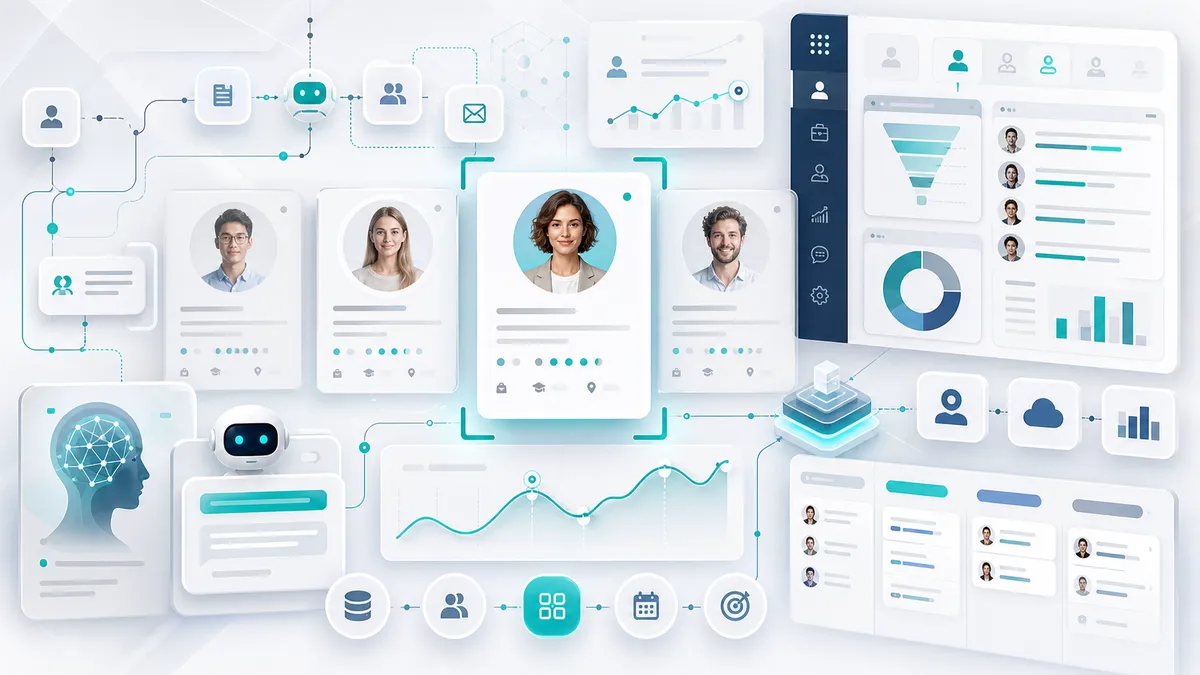
The tools shaping modern recruiting — and why human expertise still matters most
Every few years the recruiting industry reaches a technological turning point. LinkedIn once changed the way we find candidates. Then ATS (applicant tracking system) platforms such as Greenhouse and Lever slowly turned spreadsheets into a relic. 2026 looks like another such moment.
The recruiter’s tech stack is being rebuilt from the ground up: from the core infrastructure that supports every interaction with candidates to AI assistants that offer recommendations in real time. For heads of in-house HR teams and directors of recruiting agencies, the question is no longer “Do we need to upgrade?” It is now “How fast do we need to do it?”
Why 2026 is a turning point for recruiting technology
Three major shifts meet in 2026: talent shortages, new candidate expectations and the mass adoption of AI. The old “post a vacancy and wait for applications” approach has stopped working for good. Recruiters are increasingly becoming technologists as well as people specialists.
Companies are abandoning legacy systems — the bulky ATS relics of the early 2010s — and moving to more flexible, modular stacks with AI tools built in from the start. It is a bit like the move from fossil fuels to clean energy: you can resist, but sooner or later you will run out of road.
The main reason 2026 feels different is that the technology has matured. AI models, including GPT-based sourcing assistants and specialised HR language models, have gone from impressive demos to dependable everyday tools. Recruiters source through platforms such as hireEZ, Humanly.io and SeekOut, while using solutions such as HiredScore and Eightfold AI to predict quality of hire.
This revolution sped up out of necessity, not comfort. Budgets are tighter, the hiring freezes that followed 2025 are gradually lifting, and teams have to do more with less. In that situation smarter technology is not a luxury — it is the only answer that works.
Senior leadership is getting involved too. CFOs who used to pay little attention to “talent acquisition platforms” now ask about ROI dashboards, process automation and candidate sentiment metrics. Recruiting technology has suddenly become a boardroom topic.
2026 is not just another software upgrade cycle. It is the moment the recruiter becomes a strategic technologist — even if nobody asked for that line to be added to their job description.
The new core stack: ATS, CRM and AI working in sync
For years recruiters talked about a “holy trinity”: the ATS, the CRM and sourcing tools. In 2026 that trinity is turning into a synchronised nervous system.
Modern systems for managing applications and candidates — Greenhouse, Workable and Teamtailor, for example — are becoming the central hub. CRM platforms such as Beamery, Avature and Bullhorn help maintain relationships with candidates between hiring cycles. AI is built into every layer: it resurfaces strong candidates from past selection rounds, automates communication and helps meet diversity, equity and inclusion requirements from the very first contact.
The new ecosystem is built around synchronisation rather than separate tools. Picture an ATS that automatically moves strong candidates who did not make the final round into a CRM pipeline. There they are tagged with notes from an AI screening assistant, and then they receive a personalised message through a recruitment marketing platform such as Phenom People or SmashFlyX. This loop runs around the clock.
As a result, hiring managers get sharper shortlists faster, and recruiters win back time for the work that genuinely needs a human: explaining what the role is really about, understanding what motivates the candidate and building trust.
The most interesting — and in some ways unsettling — part is that everything now “talks” to everything else. When your ATS “knows” which personality traits your best employees share, thanks to tools such as Pymetrics or Bryq, matching candidates becomes almost instant. But the main challenge is no longer collecting as much data as possible. It is managing that data wisely.
Recruiters need to be clear about where automation should stop and where empathy should begin.
How strong recruiters use automation to hire faster
The best recruiters use automation not to replace themselves but to scale the human touch.
Imagine a call with a hiring manager that a tool like Metaview has already prepared you for: it has summarised every conversation with the candidates in plain language. Or scheduling chats through Calendly, GoodTime or Paradox Olivia that remove the endless back-and-forth over interview times.
Yes, these tools save hours. More importantly, they free up the recruiter’s attention for meaningful work with candidates, storytelling and care for the candidate experience.
Some of the best recruiters use automation to amplify their professional instinct. They set up Zapier workflows to tag and segment candidate types in the CRM automatically. Or they build Notion dashboards with AI summaries of the pipeline. At companies such as Shopify and HubSpot, recruiting teams run “automation hackathons” where they share workflow templates.
It is a new way of sharing expertise in the talent acquisition community.
But the golden rule has not changed: automate the boring, humanise the complex. If the automation looks impressive but the hiring process feels robotic, the employer brand takes a hit. The strongest recruiters in 2026 are not simply chasing speed. They are after meaningful speed — the kind where efficiency serves empathy.
The rise of predictive analytics in sourcing
Recruiters used to read CVs and make educated guesses. Now they train predictive models.
Tools such as Eightfold AI and Celential.ai can already predict which candidates are more likely to accept an offer, leave the company or perform strongly within a year. Predictive sourcing is not magic. It is data, patterns and a little probabilistic humility.
The interesting twist is that recruiters are becoming translators between data and human context. They speak the language of quantitative and qualitative assessment at the same time.
One in-house recruiter at Siemens described how their predictive model ranked engineers by attrition risk and by how well their soft skills fitted the team culture. With that logic, sourcing stops being guesswork. It becomes targeted, data-backed relationship building.
But prediction is slippery ground. The temptation to over-trust algorithms can end up scaling bias. That is why tools such as SeekOut and Beamery now provide explainability reports that show why the model made a particular recommendation.
Over the next decade, the winners will be recruiters who can combine professional judgement with digital forecasts.
Chatbots, AI assistants and the end of cold-outreach fatigue
Let’s be honest: nobody wants another template message along the lines of “Hi, I came across your profile…”. The chatbots of 2026 are gradually bringing that era to a close.
Platforms such as Paradox Olivia and HireVue’s AI assistants can hold natural conversations with candidates, schedule interviews, answer common questions and even suggest next steps based on the tone of the conversation.
AI assistants for recruiters — LinkedIn Recruiter 2026 Copilot or GEM’s AI Outreach Assistant, for example — are the quiet heroes of this process. They help write personalised messages that genuinely sound human: they weave in mutual connections, portfolio achievements or details of professional experience without tipping into awkward artificiality.
Outreach feels more like a conversation and less like a mailing.
The biggest benefit is that recruiters get their headspace back. Instead of writing 80 follow-up messages, they can have lunch with hiring managers, calibrate the role more precisely or prepare a personalised “why you should choose us” pitch for a strong candidate.
When technology absorbs the noise, the human voice can be heard again.
Why integrations matter more than individual tools
In 2026 a recruiter’s strength depends less on which tools they have and more on how well those tools are connected. Integrations are the circulatory system of the modern talent acquisition tech stack.
Without integrations, you are still exporting CSV files by hand at midnight. With them, your processes run like a well-tuned orchestra.
APIs are the new currency. Technology players such as Ashby, Lever and Greenhouse now take pride in open ecosystems: video interview tools such as Spark Hire and assessment platforms such as Codility plug into them easily. Integrators such as Zapier and Make (formerly Integromat) let recruiters with no coding skills build complex automations overnight.
An integration-first approach is also changing how technology is bought. Instead of one monolithic all-in-one system, recruiters increasingly choose a connected set of microservices: each one best in its category, each one replaceable.
The stack becomes modular, adaptable and — oddly enough — more human.
Balancing human intuition with data precision
No dashboard in the world can fully replace the instinct of an experienced recruiter who sees a spark in a candidate. But even that instinct benefits from calibration.
In 2026 a recruiter’s competitive edge is the combination of empathy and analytics. Intuition and information are starting to work in symbiosis rather than against each other.
Picture a recruiter who senses that a candidate may be overqualified for the role. They then check the candidate’s AI engagement-likelihood score in HiredScore and confirm the hypothesis with data. That is not surrender to the machine. It is collaboration.
This is how human and algorithm combine into a new kind of augmented professionalism.
But balance requires humility. Data can suggest; it should not make the decision for a person. The recruiter of the future knows when to go against the algorithm, when to listen more closely to the candidate’s story and when to let silence take the place of automation.
Because at the end of the funnel, two people still meet — in person or online. Nothing can replace that moment.
Which tools recruiters are dropping — and what that says about us
By 2026 recruiters are increasingly saying goodbye to first-generation HR tech that once impressed and now only slows work down. Clunky ATS interfaces, overloaded sourcing extensions and rigid CRMs are fading into the past.
Ask anyone who has migrated away from Taleo or iCIMS in the past twelve months: it feels like moving from dial-up to broadband.
What we leave behind tells an important story. Recruiters are rejecting not just inefficiency but friction. They will no longer put up with systems that hide candidate data behind complicated access rights or take five clicks to schedule a single interview.
Simplicity is the new sophistication. The stack should serve the user, not the software vendor.
This clear-out also reflects a cultural shift. TA teams are thinking more about digital wellbeing: choosing fewer, better tools — ones that support creative flow rather than breaking it. When software becomes almost invisible, recruiting returns to its essence: human connection.
Data ethics, transparency and the human cost of AI
The dark side of the 2026 technology boom is its ethical complexity.
When predictive models decide who moves forward and voice analysis tools try to draw conclusions about “culture fit”, the stakes become very high. Bias does not go away. It just scales faster.
Recruiters need to become not merely users of technology but its responsible stewards.
The major players are already responding. Companies such as SAP SuccessFactors and Beamery publish ethical AI frameworks that let recruiters check where training data comes from and how models behave. Transparency is becoming a new competitive advantage.
Soon candidates will choose employers not only on salary but on how companies handle data.
Recruiters are starting to grasp something important: the right technology is not only about efficiency. It is also about human dignity. The industry’s legacy will depend less on who built the fastest candidate-search engine and more on who used it responsibly.
How to build the tech stack of the future without losing its soul
How do you prepare for what comes next?
The winning tech stacks of 2026 will combine flexibility with humanity. They will integrate easily, predict carefully, automate ethically and still leave room for the recruiter’s irreplaceable intuition.
Leading teams at Airbnb, Deloitte and HubSpot are already testing human-in-the-loop recruiting models, where a person stays inside the decision-making loop. In these systems AI proposes, but the final decision rests with the recruiter. Human judgement is preserved while repetitive tasks are handed to technology.
This approach looks like a promising template for anyone seeking a balance between progress and purpose.
In the end, a tech stack is only as “alive” as the people who run it. The recruiter’s mission is not to outsmart the machines. It is to use technology to hire more humanely.
In 2026 and beyond, that may well become the main competitive advantage.
Every recruiting revolution creates its own winners. They are the ones who adapt earlier, experiment more boldly and never forget why this work exists in the first place: to connect people with opportunities.
In 2026 the recruiter’s tech stack is no longer just a set of tools. It is a philosophy and a living ecosystem. Build it wisely, use it ethically and keep its human core. The future of hiring depends on it.
Need a strong sales specialist or sales leader?
Discuss a hire