

AI literacy in candidates: what to consider when hiring
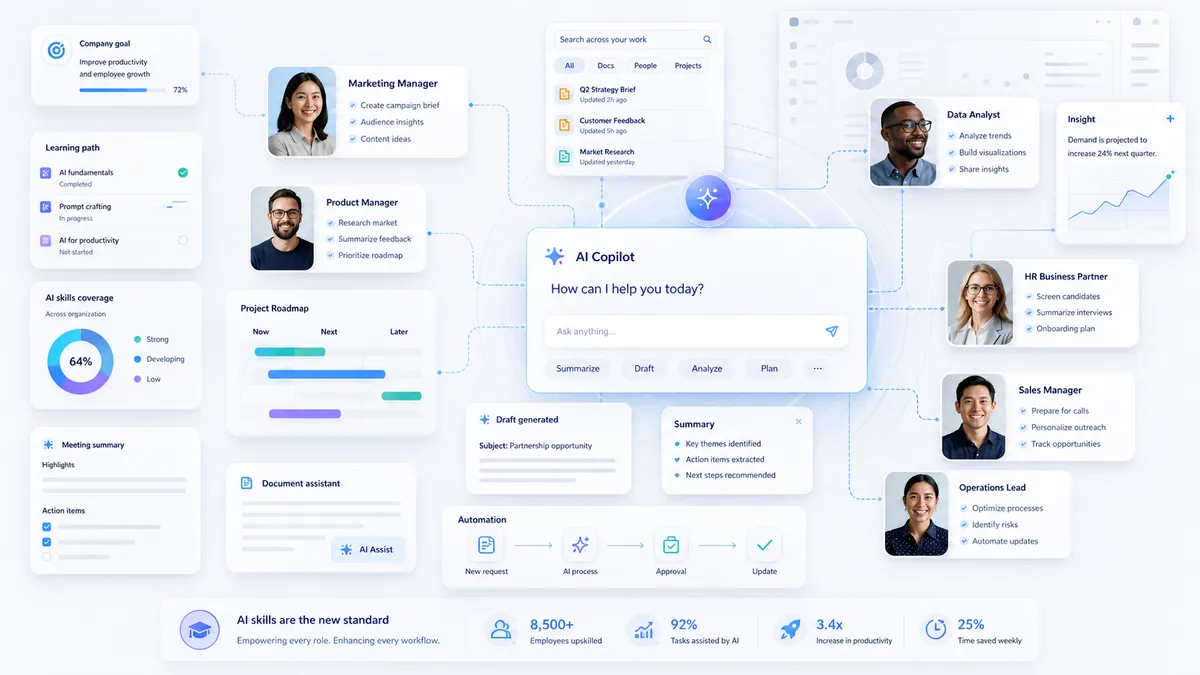
If you are looking for a new job, or simply want to feel more secure in the one you have, get hands-on experience with AI tools as soon as you can. The reason is simple: business leaders around the world increasingly see that tools such as ChatGPT, Microsoft Copilot and AI search make a real difference to productivity and expand what every employee can do.
AI productivity tools are developing so quickly that practical experience with them could become a universal requirement almost overnight — both for getting a job and for keeping it.
Strategically, this sharp shift in what employers expect may be the biggest change since computer literacy became a standard hiring condition in the early 2000s. So there is no point in putting off preparation. Jobseekers, employees, managers, hiring managers and recruiters all need to start acting now.
Takeaway 1. The new requirement will affect both candidates and current employees
At first, many people may decide that a warning about a new requirement — experience with AI tools — has nothing to do with them. That could turn out to be a serious mistake.
In a world where AI can already handle a wide range of tasks, this requirement will directly shape who gets hired. And it will have just as strong an effect on job security for people already inside the company.
From now on, employees who cannot use existing and emerging AI tools effectively in their work will be at a disadvantage. In the author’s view, they are the most likely to be first on the list when redundancies come.
Takeaway 2. Understand why AI tools will matter in every profession
Most of what is written about AI in recruitment still focuses on hiring AI engineers and data centre specialists for big companies such as Meta and Microsoft. Yet the far bigger impact on business will come not from hiring narrow AI specialists but from the everyday use of AI tools by employees in all kinds of roles.
These tools will let people produce more high-quality work in less time. In some cases, they will allow employees to do things that were simply impossible without AI software and AI agents.
Takeaway 3. Hiring people with AI tool experience may become one of recruiting’s most important tasks
Many believe that the main task for talent acquisition in the coming years will be hiring AI developers and infrastructure specialists. The author thinks this is not quite right.
By his estimate, up to 25% of tasks in most professions will soon be done with AI tools. Given the productivity gains and new capabilities these tools bring to almost every role, the return on this kind of hiring could be enormous.
This means strong recruiting leaders will probably conclude that requiring experience with AI tools will become one of the areas of greatest impact within the recruitment function.
Today it is already impossible to be productive in almost any role without knowing how to use different kinds of software: office, information, analytics and communication tools.
The author predicts that very soon it will be just as impossible to do a job well without experience of the AI tools relevant to that role.
How to put an AI-focused recruiting strategy in place
For those ready to start preparing for the new requirement, here are practical steps and recommendations.
Define which AI tools each role needs
Whether or not a company launches a dedicated hiring strategy built around AI tools, every hiring manager will still have to decide which specific AI tools a given role requires.
This work should be done jointly with operations and the IT team. Otherwise the requirements for candidates will be too general and the assessment superficial.
Make AI tool experience a formal requirement
This is arguably the most important step in the whole strategy. Experience with AI tools should be not a nice-to-have but a mandatory requirement for the specific role.
That means updating the job description, employer brand materials and current screening processes. Screening has to be able to separate candidates who genuinely meet the new requirement from those who simply mention AI in their CV.
State the requirement clearly in job ads
Candidates should see straight away how important this new condition is. Job ads need to be revised so they state plainly that experience with specific AI tools is a mandatory requirement.
It is also worth spelling out in the ad that candidates are expected to provide convincing evidence of their AI skills.
Learn to attract experienced AI tool users
People who already know how to use AI tools effectively will be in high demand. Most of them are probably already employed.
So a company will need a systematic, data-driven approach to sourcing. It has to find these specialists and also be able to persuade the best of them to consider moving to your company.
Assessing candidates will not be easy
In many cases it would be a big mistake to take candidates at their word when they simply list experience with AI tools. Healthy scepticism is essential here.
The author suggests paying particular attention to testing AI skills at the finalist interview stage. For example, you could run a phone interview focused specifically on the candidate’s hands-on experience with the tools the role needs.
You can also use tests from solution vendors, interviews with future colleagues, or a practical demonstration of skills during the final on-site interview.
Selling the role to finalists will get harder too
Because candidates with proven AI experience will be in demand, most finalists will already have a job. To close these candidates, recruiters will need to work on candidate motivation in a stronger and more precise way.
In other words, you need to know in advance which conditions, arguments and elements of the offer will actually persuade a particular person to accept it.
Look more closely at candidates who use AI in their job search
If your company currently penalises or screens out candidates for using AI during their job search, the author advises dropping the practice.
On the contrary, these candidates deserve a closer look. The very fact that someone uses AI tools to look for work may show that they are an early adopter who already knows how to apply the technology in practice.
Don’t count on onboarding training to solve the problem
You might ask: why hire people who already have AI experience if you can train every new hire once they start?
In the author’s view, in most cases this would be a weak solution.
First, even if the L&D team is able to train staff on AI tools, it will probably already be busy training existing employees.
Second, training instead of proven experience is a risky bet. The company cannot know in advance what share of trained employees will actually be able to apply these skills in their work.
Third, training can take months. For most managers that is unacceptable, because they need people who can use AI tools from day one.
Candidates must be able to keep learning
Their current level of AI proficiency will not be enough on its own. Things in AI and technology change too quickly.
So every employee will need the ability to keep learning, pick up new tools and prepare in advance for the next wave of technological change.
Retention will need dedicated effort
Demand for employees who can use AI tools in their work will outstrip supply for a long time. So companies will have to not only hire these people but also actively retain those they have already brought in.
Retention should be a continuous, proactive process, not a reactive one.
You need a convincing business case
If the new strategy requires funding, recruiting leaders will have to work with the company’s operations and finance teams.
The goal is to build a convincing business case for sceptical hiring managers and executives. Everyone involved should understand why the company is investing in a new type of recruiting strategy and what return it expects.
Be sure to introduce performance metrics
As with any new recruiting strategy, you need to collect data on how well the programme works.
Companies should develop and introduce metrics that show whether new hires actually scored highly when their AI skills were tested before hiring, and whether they use those skills to work more effectively on the job.
Which AI tools to look for when hiring
First and foremost, companies should look for candidates with experience in the AI tools already used inside the business. If there is no such list yet, you can start from the most widely used solutions and platforms:
ChatGPT — conversational AI and productivity tool: working with text, ideas, structure, analysis and everyday work tasks.
Google Gemini — conversational AI and AI search that can be used to find information, analyse it and work with data within the Google ecosystem.
Doubao — a conversational AI tool widely used in China.
Quark — a productivity and search tool, also aimed primarily at the Chinese market.
Baidu Wangpan — cloud storage and productivity tool in China’s digital ecosystem.
DeepSeek — conversational AI and a tool for research tasks, information analysis and working with queries.
Perplexity AI — AI search and a question-answering service that cites its sources.
Grok by xAI — conversational AI that is also used for entertainment and information.
Claude — conversational AI, including for business use, working with text, documents and analytical tasks.
Canva — a content creation and productivity tool. Not every use of Canva involves AI, though.
Conclusions
AI skills are quickly turning from an added advantage into a new professional norm. Just as computer skills once became mandatory for almost every office role, the ability to use AI tools is gradually becoming a basic requirement for employees and candidates alike.
For jobseekers, this means experience in their profession alone may soon not be enough: employers will increasingly check whether a person can apply AI to real work tasks. For current employees, it is a question of competitiveness and job security. Those who can analyse information faster, prepare materials, automate routine work and strengthen their output with AI gain a clear advantage.
For companies and recruiters, the main takeaway is even more practical: AI skills should not simply be mentioned in job ads but built into the hiring system itself. You need to know which tools matter for each role, how to test a candidate’s real skills, how to tell genuine experience from a well-turned phrase in a CV, and how to retain employees who already know how to work with AI.
The labour market is entering a stage where AI literacy is becoming part of basic professional qualifications. It is better to start preparing now — revising requirements, learning, testing tools and building new assessment criteria — than to catch up once these changes have already become the mandatory standard.
Need a strong sales specialist or sales leader?
Discuss a hire