

HR trends 2026: AI, skills-based hiring and culture
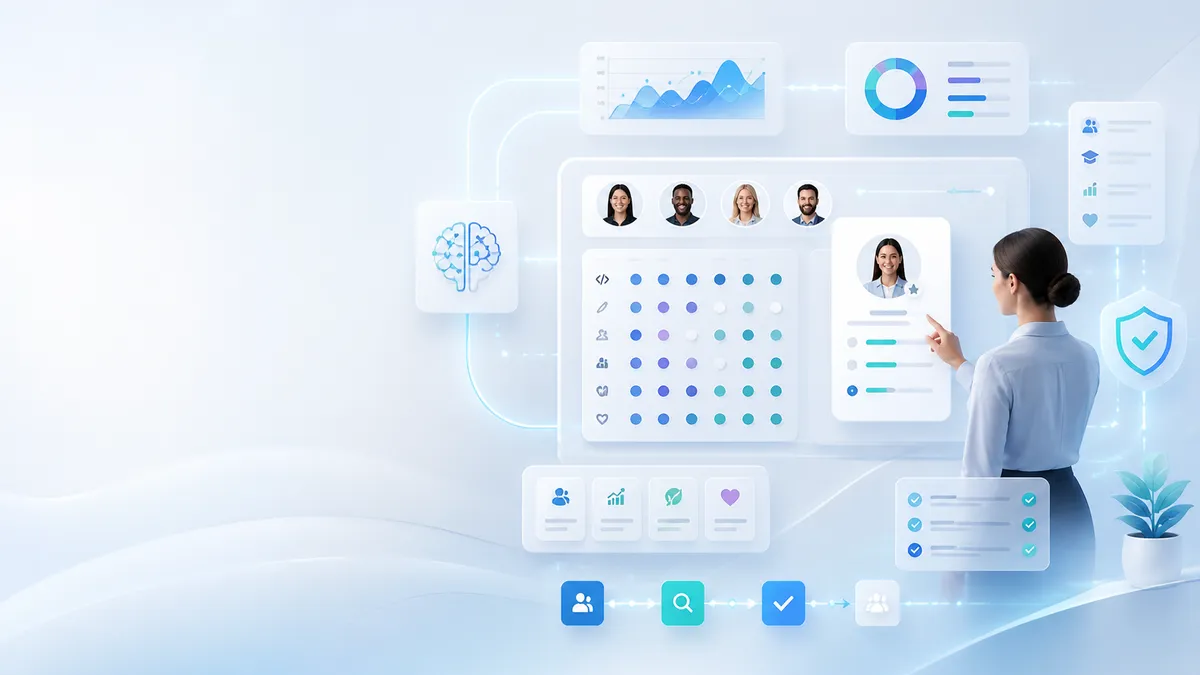
In 2026 HR finally stops being just a function for recruitment, onboarding and personnel administration. More complex tasks move to the top of the agenda: how to build artificial intelligence into management without losing control; how to develop employees’ skills in an unstable labour market; how to sustain culture when change has become permanent; and how to stay clear of the legal risks surrounding diversity and inclusion programmes.
Artificial intelligence will remain one of the main topics for HR teams. But the agenda itself is changing. Where companies used to mostly experiment with AI, HR is now expected to deliver something else: clear integration of the technology into everyday work, transparent rules for its use and demonstrable value for the business.
AI is not the only challenge, though. The labour market remains tense, employers increasingly look at real skills rather than just job titles and CVs, and in many companies corporate culture is weakening as employees tire of endless change.
For HR leaders, 2026 will test not how quickly they can pick up the next trend, but whether they can connect technology, skills, culture and management into a single system that works.
AI in HR: from experiments to a management system
Over the past twelve months artificial intelligence has taken up a disproportionate share of the HR industry’s attention. That is hardly surprising: AI already helps automate routine tasks, speeds up work with data and is gradually becoming part of management processes.
The next stage will be harder. HR teams will have to separate the technology’s real value from the noise around it. Experiments alone are no longer enough. What matters is not the fact of adopting AI but how effectively it is built into day-to-day work — and whether it genuinely helps the company make better decisions.
Adopting artificial intelligence in HR can be roughly divided into two levels.
The first is automating repetitive operations: initial CV screening, answering standard employee questions, processing HR requests, supporting internal services, analysing routine data and other processes where technology takes manual work off the team.
The second level is harder: using AI as a management tool. This is no longer just about speeding up individual tasks, but about building artificial intelligence into managers’ work, employee development, performance assessment and people decisions.
This is where many companies run into difficulties. Even large organisations often lack a clear roadmap: which AI tools to adopt, in which processes to use them, which data to connect, who is accountable for the final decision, and where the line runs between an algorithm’s recommendation and a person’s responsibility.
A telling example is a story shared by Google co-founder Sergey Brin. According to him, the Gemini tool helped identify an engineer who was not especially visible in communication but whose results merited a promotion. She did go on to be promoted. Without the signal from AI, her contribution might have gone unnoticed.
Cases like this show the real strength of artificial intelligence: it can highlight what a manager misses because of subjectivity, overload or lack of data. But it only works under one condition: the company has good-quality data and clear rules for using it.
For HR, this means a new area of responsibility. People teams need not only to roll out tools but to build a data architecture: to know where employee information is stored, who has access to it, and which data can and cannot be used for analysis.
The necessary data often already exists inside the company, but it is scattered across different systems, held by different departments and subject to different access levels. So HR will have to work not only with the technology but also with the business, IT, the legal team and team leaders. Without that, AI quickly turns from a management aid into a source of errors and risk.
Rules for using AI will become a mandatory part of HR strategy
There are already plenty of worrying examples around artificial intelligence: errors in workflows, opaque algorithmic decisions, risks of discrimination, and AI used as a box-ticking substitute for a real assessment of a person. So in 2026 HR teams will have to deal not only with adopting the technology but with setting clear limits.
A particularly difficult area is the unofficial use of AI by employees and managers. A manager may ask a chatbot to write a performance review for a direct report. A recruiter may use AI to assess a candidate. An employee may hand part of their work over to a tool without telling their manager.
This practice is not always bad in itself. The problem arises when the company does not know where exactly AI is being used, what data is being fed into it and who is accountable for the final decision.
In 2026 it is critical for HR to answer several questions:
- can AI be used to assess employees;
- is it acceptable to use AI when writing performance reviews;
- which employee data must not be uploaded to external tools;
- where AI can make a recommendation but must not make the decision;
- who is responsible for an algorithm’s mistake;
- how to explain to employees what exactly is being analysed and why.
Without such rules, the company risks getting management noise rather than higher efficiency. AI will be used piecemeal, differently in different teams and without common standards. In the end the technology will amplify the organisation’s weak spots rather than its best practices.
HR’s main task is not to ban AI but to make its use manageable. That requires internal policies, training for managers, clear use cases and regular checks on how the technology affects decisions about people.
The labour market remains unstable, so skills come first
The labour market enters 2026 in a state of uncertainty. In 2025 lay-offs reached historically high levels at certain points. In October alone, job cuts rose by 175% compared with the same period a year earlier — the highest monthly figure for a fourth quarter since 2008, according to Challenger, Gray & Christmas.
AI is already cited as one of the factors that may reshape the structure of employment. Entry-level specialists, operational staff and administrative functions are especially vulnerable. Wherever tasks are easy to describe, standardise and automate, businesses will increasingly look to technology.
Against this background, skills are becoming employers’ main point of reference. A formal job title describes a person’s real value to the business less and less well. The same job title can hide very different levels of competence, independence, adaptability and ability to work with new tools.
That is why companies are moving more actively towards skills-based hiring. For HR, this means assessing candidates more precisely: not only by the experience on their CV, their job title or the reputation of their previous employer, but by the specific competencies needed to deliver results.
A McLean & Co. survey found that skills-based hiring is one of the most actively adopted and planned of the new HR trends. At the same time, 54% of respondents believe that developing employees’ AI skills will have a strong impact on their organisation in the future. Yet as of last year, only 1% of companies had already implemented such a strategy.
This gap matters. Businesses already understand that skills are becoming critical, but rarely know how to manage them systematically. In 2026 this will be one of HR’s biggest challenges.
An employee skills map: why HR needs competency analytics
To move to skills management, a company first needs to understand which competencies already exist inside the organisation. HR can use data analytics to do this and build internal skills maps of its employees.
An example of this approach is described in an academic study of Johnson & Johnson. The company built a platform that used machine learning to determine skill proficiency levels based on data from its HR information system. The AI engine assigned competency scores, which employees and their line managers then confirmed or corrected.
The point of this approach is not to replace people with an algorithm. On the contrary, a strong model combines data, AI analysis and human review. The algorithm helps show the big picture, but employees and managers must be able to influence both the inputs and the outputs.
For companies that want to introduce similar solutions, three principles matter.
First, you need to know what kind of workforce the company wants to build in the future. A skills map only makes sense when it is tied to business strategy: new products, markets, technologies, the operating model and growth plans.
Second, data regulation and ethical constraints must be taken into account. Employee information is a sensitive area, especially when it is used for assessment, promotion, training or reallocating opportunities.
Third, employees should not be passive objects of analysis. If AI assesses their skills, people must be able to see, clarify and challenge that data. Otherwise the system will quickly lose trust.
For HR, this changes the very approach to people development. Training stops being a collection of disconnected courses and becomes a managed process: the company sees current competency levels, understands future needs and can invest in development more precisely.
Employees’ AI skills will become a development area in their own right
A separate theme for 2026 is developing AI skills inside companies. If artificial intelligence is becoming part of workflows, employees need to understand not only how to use the tools but where the limits of their use lie.
AI literacy will have several levels.
The first is a basic understanding of the tools: how to write prompts, check results and use AI to speed up routine tasks.
The second is critical thinking: understanding where the algorithm can be wrong, why its output cannot be taken on trust and which data must not be shared with external services.
The third is practical use within a specific profession. For a recruiter, that might mean analysing a vacancy and the candidate market. For an HRBP, preparing analytics on teams. For a manager, structuring feedback, development plans and working meetings.
The fourth is ethics and responsibility. Employees need to understand that AI can be an assistant but must not become a way to shed responsibility for decisions that affect people.
For HR, this means AI training cannot be limited to a short guide to the tools. It needs a proper system: a usage policy, practical scenarios, training for managers and regular updates to the rules.
Culture atrophy: why employees can no longer keep up with change
Constant change has become the norm for business, but for employees that norm is often exhausting. New technologies, team restructures, hybrid work, lay-offs, rebuilt processes and pressure on efficiency create the feeling that there is no stable footing any more.
In its report on CHRO priorities for 2026, Gartner describes this state as “culture atrophy”. The idea is that corporate culture does not disappear overnight but gradually weakens. People have a poorer grasp of shared rules, feel less connected to the company, engage less in development and more often experience change as chaos.
This is dangerous for business. A weak culture directly affects productivity, retention, the quality of management and the company’s ability to adapt. If people do not trust their managers and do not understand where the organisation is heading, even a strong strategy starts to stall.
One way to counter culture atrophy is to bring human contact back into management. Regular one-to-ones, good-quality feedback, clear conversations about development and consistently keeping commitments become part of the strategy rather than a formality.
Lisa Moore of Yahoo stresses that human connection is a strategic advantage, and that it starts with managers whom the company trains and empowers. Yahoo, for example, relies on quarterly workshops for leaders, where managers gain practical skills and access to an internal support network.
The core idea is simple: employee development should not be a once-a-year conversation. It should be a continuous process built on clarity, feedback, regular adjustment and trust.
The manager’s new role: linking technology, development and culture
Against the backdrop of all these trends, the manager’s role becomes even more important. AI can provide data, HR can design policy, the company can launch training — but it is the manager who turns all of this into the employee’s everyday experience.
In 2026 a manager needs to work on several fronts at once.
They need to know how to use AI without giving up responsibility. To discuss skills development with their people. To give regular feedback. To maintain trust within the team. To explain change. And to do all this without turning people management into a set of formal procedures.
For HR, this means manager development should become one of its central areas of work. Giving leaders tools is not enough. They need to be taught to use those tools in real management situations: assessment, development, difficult conversations, change and supporting the team.
It is managers who will decide whether AI becomes an assistant or a source of mistrust, whether a skills map becomes a useful development tool or just another administrative system, and whether the company keeps its culture amid constant change or loses touch with its people.
What all this means for HR strategy in 2026
The 2026 HR agenda shows that people management is becoming ever more technology-driven, yet ever more dependent on the quality of human decisions.
AI can speed up processes, surface hidden patterns and help managers make better decisions. But without rules, good-quality data and accountability, it creates new risks.
Skills-based hiring can make the labour market more precise and fairer. But for that, companies need to learn to see the real competencies of employees and candidates, not just the job titles on their CVs.
DEI programmes can support a strong and diverse culture. But in the new legal environment they require care, transparency and competent handling.
Corporate culture can be a powerful advantage. But it will not survive constant change if managers cannot build trust, give feedback and support employee development.
In 2026 the winners will not be the HR teams that roll out the next tool faster than everyone else. They will be the ones that manage to connect technology, skills, culture and management into a single system that works.
Key takeaways
- AI in HR is moving from experiments to systematic integration into management.
- HR’s main task is not only to adopt AI but to set the rules for its use.
- Unofficial use of AI by employees and managers will become a source of risk in its own right.
- Skills-based hiring is becoming one of the key approaches in an unstable labour market.
- Companies need employee competency maps and a clear strategy for developing AI skills.
- Corporate culture is weakening under the pressure of constant change.
- The manager’s role is central again: without trust, feedback and human contact, HR strategy will not work.
Need a strong sales specialist or sales leader?
Discuss a hire